Ever Wondered What Really Goes Into Your Moisturiser?
If you've ever turned a jar over to squint at the ingredients list and felt a flicker of curiosity, you're already halfway to learning how to make your own natural skincare. The truth is, formulating from scratch isn't reserved for chemists in white coats. It's a skill any curious person can pick up, one batch at a time. When you make your own natural skincare, you decide exactly which plant-derived oils, butters and actives go in, and at what concentration. This guide walks you through the science of why formulations work, the building blocks you'll need, and a beginner-friendly method to get you started with confidence.
Understanding the Science Behind a Formulation
Most skincare products are emulsions. A stable blend of oil and water that won't normally mix on their own. Understanding this is the foundation of homemade natural skincare. An emulsion needs three things: an oil phase, a water phase, and an emulsifier to hold them together.
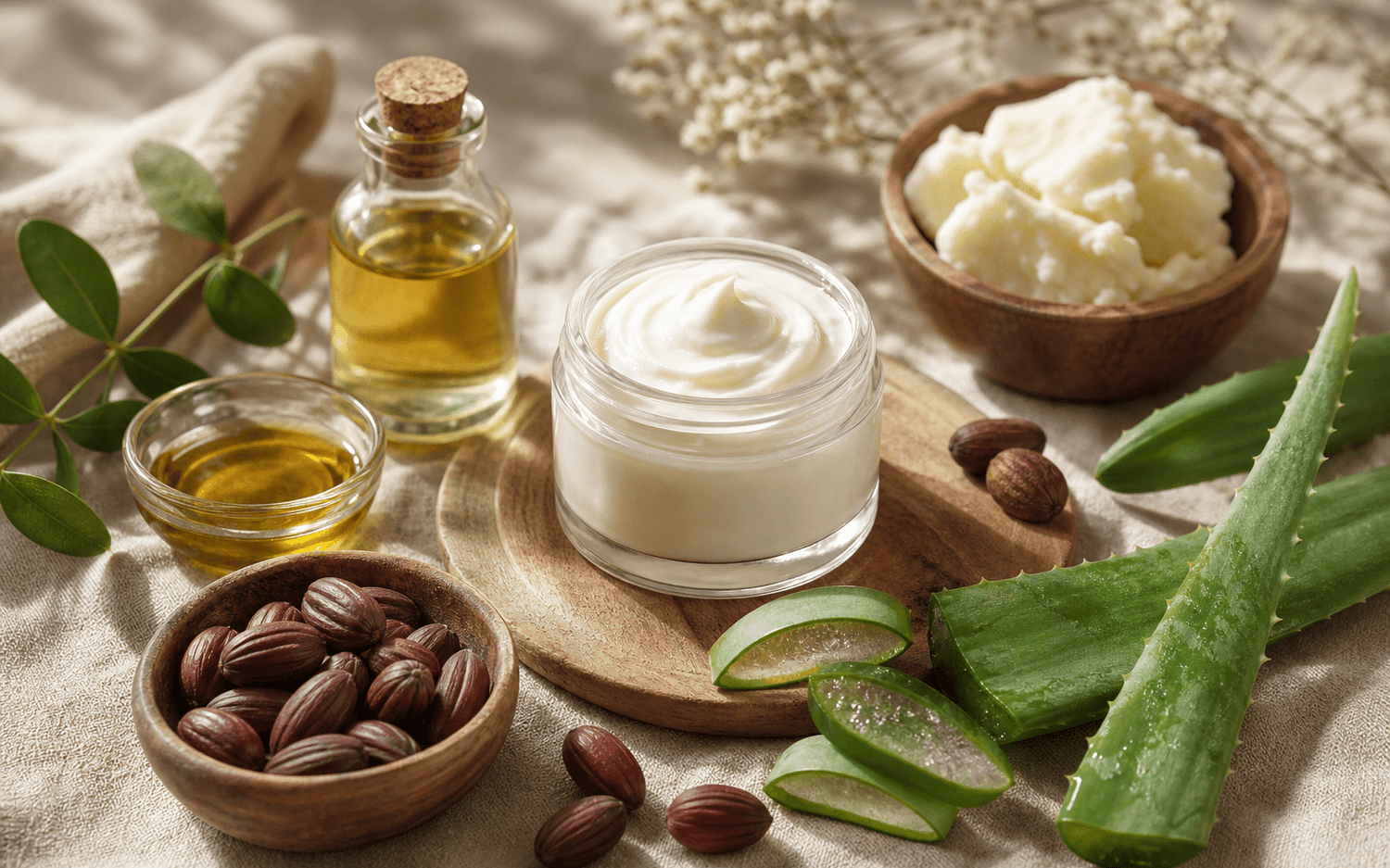
The oil phase is where your carrier oils and cosmetic butters live. These deliver fatty acids that support the skin's barrier. Oleic acid (found generously in olive oil, INCI: Olea Europaea Fruit Oil) is a rich, cushioning fatty acid, while linoleic acid (abundant in sunflower and rosehip oils) is lighter and more readily absorbed. Shea butter (INCI: Butyrospermum Parkii Butter) is prized for its stearic and oleic acid content, making it a wonderful softening cosmetic butter for richer creams.
The water phase carries humectants. Ingredients that draw moisture toward the skin. Glycerine (INCI: Glycerin) and aloe vera are classic examples. Understanding which fatty acids and actives you're working with lets you tailor a formula to the result you want, rather than guessing.
Why You Can't Skip the Preservative
Here's the single most important lesson when you make your own natural skincare: any product containing water needs a broad-spectrum preservative. Without one, bacteria, yeast and mould begin colonising your cream within days, even if it looks and smells perfectly fine. For any product that contains water, a broad-spectrum preservative is essential. It's what protects your formulation against bacteria, yeast and mould, helping keep it safe to use. We cover this in more depth in our guide to preserving your natural skincare.
The Core Building Blocks
Before you start, gather your essentials. You don't need a vast collection. A handful of versatile ingredients will see you through dozens of recipes.
Emulsifiers
An emulsifier is what transforms separate oil and water into a smooth, stable cream. For beginners, an all-in-one emulsifier takes much of the guesswork out of the process. These bring the two phases together at a sensible usage rate and produce reliably stable results, which is exactly what you want for your first few batches.
Carrier Oils and Butters
Choose your oils based on their fatty acid profile and how they feel on the skin. Lighter oils like sunflower (INCI: Helianthus Annuus Seed Oil) absorb quickly and suit facial formulations, while richer choices like shea butter and cocoa butter (INCI: Theobroma Cacao Seed Butter) lend body to balms and thicker creams. Mixing a fast-absorbing oil with a richer one often gives a more balanced skin feel than relying on a single ingredient.
Humectants and Actives
Glycerine is the workhorse humectant of natural skincare. A little goes a long way in the water phase. Once you're comfortable with the basics, you can introduce actives such as vitamin E (INCI: Tocopherol), which is added to the oil phase to help protect your oils from going rancid, extending the life of your formulation.
A Beginner-Friendly Method
The classic approach to making a cream follows a logical sequence. Here's the principle behind the technique:
- Weigh everything. Always work by weight, not volume, using digital scales. Skincare formulation is a percentage-based discipline, and accuracy is what makes a batch repeatable.
- Heat the two phases separately. Gently warm your oil phase (oils, butters, emulsifier) and your water phase (water, glycerine) in separate heatproof containers until both reach a similar temperature.
- Combine and blend. Pour the water phase into the oil phase and blend thoroughly. A stick blender gives a far more stable, finer emulsion than hand-stirring.
- Cool down. Once the mixture has cooled to a safe temperature, add your heat-sensitive ingredients: preservative, any essential oils, and actives like vitamin E.
If you'd like a structured starting point, our beginner's guide to making creams and lotions breaks the process down step by step.
A Note on Essential Oils
Essential oils are a lovely way to add natural fragrance, but they're potent and must be used sparingly within recommended limits. Always follow IFRA guidance for the specific oil and product type, and keep total essential oil content low in leave-on products. We recommend a patch test before using any new formulation containing essential oils, as even natural fragrance ingredients can cause sensitivity in some people. If you're new to scenting your creations, our introduction to essential oils in skincare is a helpful place to begin.
Common Pitfalls to Avoid
The most frequent issue new formulators encounter is a cream that splits or separates. This usually comes down to one of three things: the two phases weren't at a similar temperature when combined, the emulsifier was used below its effective rate, or the blend wasn't mixed vigorously enough. A second common mistake is leaving out the preservative. Never do this for any water-containing product. Finally, resist the temptation to add "a bit more" of an active or essential oil; usage rates exist for safety and stability, not to spoil your fun.
Frequently Asked Questions
Q: Can I make natural skincare without a preservative?
A: Only if your product contains no water at all. For example, an anhydrous balm or facial oil made purely from oils and butters. Any formulation containing a water phase, hydrosol or aloe vera needs a broad-spectrum preservative to remain safe to use. The only EXCEPTION is if you make it for your own personal use, store it in the fridge for a week or so while using it and then discard the rest once that time is done, as it won't keep.
Q: Do I really need scales to make my own natural skincare?
A: Yes. Skincare formulation works in percentages, and accurate digital scales are essential for repeatable, safe results. Measuring by volume with spoons or cups simply isn't precise enough for stable emulsions.
Q: Why does my homemade cream keep separating?
A: The usual culprits are mismatched phase temperatures, too little emulsifier, or insufficient blending. Make sure both phases are similarly warm before combining, use your emulsifier at its recommended rate, and blend thoroughly with a stick blender.
Q: How long will my natural skincare last?
A: With a suitable preservative and clean working practices, a water-based cream typically keeps for several months. Anhydrous products like balms last longer. Always store finished products away from heat and light, and use clean, dry hands or a spatula to avoid introducing contamination.
Q: Which ingredients should I start with as a complete beginner?
A: Begin with a simple, reliable all-in-one emulsifier, one or two versatile carrier oils, glycerine as your humectant, and a broad-spectrum preservative. This small kit lets you make a surprising variety of creams and lotions before you expand into actives.
Ready to Make Your First Batch?
Learning to make your own natural skincare is genuinely rewarding, and it's far more approachable than it looks once you understand the science of emulsions and the role each ingredient plays. Browse our carrier oils collection to choose oils that suit your skin feel, explore our emulsifiers range to find a beginner-friendly all-in-one option, and don't forget to pick up a preservative so your creations stay safe and fresh. Start small, weigh accurately, and enjoy the satisfaction of using something you made yourself today.